

India is not an easy regulatory environment to keep up with. Every working day, central ministries, state governments, and sector regulators publish notifications, circulars, and amendments across dozens of separate websites with no single place where all of it lands. For compliance, legal, and government affairs teams, policy tracking and staying on top of regulatory updates India are among the most time consuming responsibilities in the organisation. This guide covers how to track policy changes in India, where government policy updates in India are published, how to track government policy changes without gaps, and what the best way to track government policy updates in India actually looks like, turning policy monitoring from a manual burden into a structured process.
Why Organisations Must Track Policy Changes in India to Avoid Risks
India has 28 states, more than 60 central and sector-level regulators, and a central government that together produces an enormous volume of government regulation updates India every single working day. The numbers are significant: on average, approximately 48 regulatory updates are published across union, state, and local bodies every working day, adding up to over 800 updates a month, more than 2,400 every quarter, and over 9,300 in a single year. Understanding why regulatory updates matter for businesses starts here. Legislative updates India in pharmaceuticals, financial services, energy, telecom, and manufacturing shape product approvals, licensing conditions, and market access. One RBI circular or revised SEBI guideline can force operational changes almost overnight. Missing an update is expensive. Consequences range from compliance penalties to missed public consultation windows and reputational damage with regulators. It is why policy research India has moved from an ad hoc activity to a dedicated function across industries.
Where Government Policy Updates Are Published in India
This is where most monitoring efforts fall apart. Keeping up with government policy updates in India means knowing how to monitor government notifications in India across multiple source types. Government notifications India, covering government gazette updates, government circular updates, parliamentary records, and regulator advisories; are spread across hundreds of portals with no unified feed.
Official Government Portals and Ministry Websites
Every central ministry operates its own website and publishes government notifications India, orders, and press releases independently. The Indian Gazette, maintained by the Ministry of Law and Justice, is the official legal record for all central government notifications and amendments; the primary source for tracking policy notifications. It publishes a regular weekly edition every Saturday, while extraordinary editions can appear on any working day when urgency demands it; meaning several gazette issues can land in a single week during active legislative periods. All central government notifications are published bilingually in both Hindi and English as mandated under the Official Languages Act, 1963, while state governments additionally publish in their respective regional languages, adding a further layer of complexity for teams monitoring across states. The Press Information Bureau covers official communications across ministries. Parliamentary questions and answers appear on the Lok Sabha and Rajya Sabha websites. This is what how to monitor government notifications in India looks like in practice.
Regulatory Authorities and Industry Regulators
Central ministries are only part of the picture. Effective regulatory monitoring must cover sector specific regulators too. SEBI governs capital markets, RBI regulates banking, TRAI oversees telecom, IRDAI manages insurance, and FSSAI handles food safety; each on its own portal with no coordination. That fragmentation is what makes regulatory intelligence so difficult. Maharashtra, Uttar Pradesh, Tamil Nadu, and Gujarat add another layer with their own state gazettes, making regulatory change tracking India at state level a separate effort entirely.
The table below summarises the main sources and what each covers.
| Source | What It Covers | Key Limitation |
| Central Ministry Websites | Ministry orders, notifications and press releases | Separate portal for every ministry, no unified feed |
| Indian Gazette | Official legal record for all central notifications | Dense legal language and high document volume |
| PIB Press Releases | Official communications across ministries | Covers announcements only, not full policy text |
| Regulator Portals (SEBI, RBI, TRAI) | Sector specific circulars and consultation papers | Fragmented across individual regulator websites |
| State Government Portals | State level policies, rules and amendments | Inconsistent formats across different states |
| AI Policy Platforms (Policy Index) | All of the above in one searchable place with summaries | Requires platform access |
Common Challenges When Tracking Policy Changes
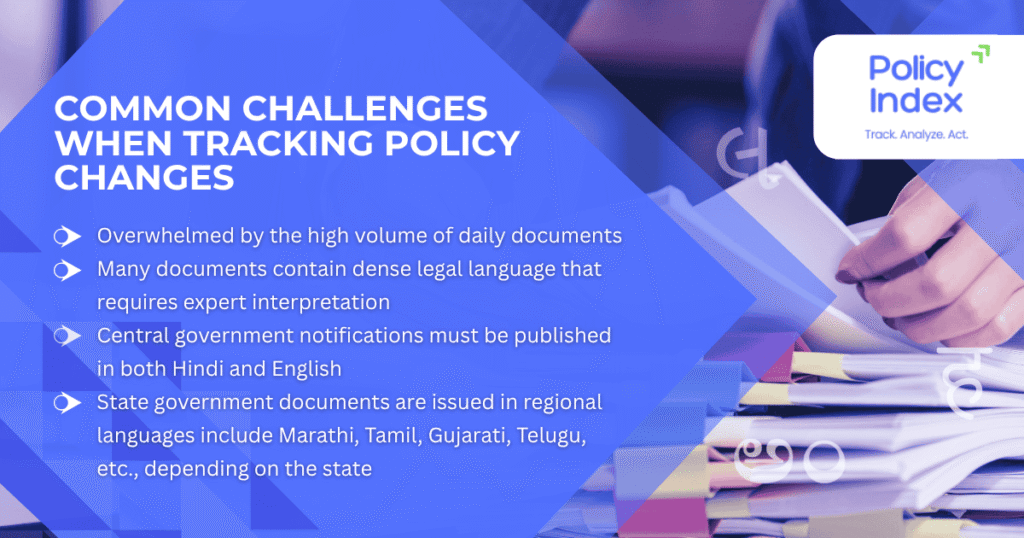
Volume is the obvious problem, but not the only one. Even with solid policy monitoring habits and regulatory monitoring processes, teams get overwhelmed by the daily document flow, much of it in dense legal language requiring expert interpretation. Add to this the language challenge: central government notifications are mandatorily published in both Hindi and English under the Official Languages Act, 1963, while state government documents arrive in regional languages such as Marathi, Tamil, Gujarati, or Telugu depending on the state. A team tracking policy across five states may be dealing with documents in four or five different languages simultaneously. Policies are also regularly updated through circulars that modify existing rules rather than replace them. To properly monitor and track policy changes in India, teams must track regulatory history, not just current versions. And this is the gap in how businesses track regulatory updates in India that creates the most risk.
Best Ways to Track Policy Changes in India Efficiently
There is no shortage of government policy updates being published. The challenge is having the right policy tracking system. From policy alerts India to dedicated policy monitoring tools India and tools to monitor regulatory changes in India, the approaches below move from the simplest to the most powerful, with regulatory intelligence at the centre of each.
Setting Up Alerts for Government Notifications
Start simple. Policy alerts India through government email subscriptions or Google Alerts cost nothing and take minutes. Coverage is patchy and important policy notifications from smaller portals often go undetected, so treat alerts as a first layer only. Subscribing directly to PIB updates and gazette services is the best way to monitor government notifications at the central level, though results still arrive fragmented.
Using Policy Monitoring Platforms
For teams that need reliable coverage, purpose built policy monitoring tools India are the better choice. These are tools to monitor regulatory changes in India that pull official documents from central ministries, regulators, and state governments into one searchable library; one search instead of dozens of portal checks. The document intelligence layer adds AI generated summaries, glossaries, and plain language Q&A on specific documents, bringing genuine regulatory intelligence to every search. That is what makes a policy intelligence platform different from a basic aggregator, and why these tools for policy monitoring in India change how compliance teams operate.
How AI Tools Are Improving Policy Tracking and Monitoring
Traditional search finds documents that match your keywords. AI tools to track policy changes in India go further, turning a policy intelligence platform into something genuinely useful. Semantic search understands query intent and returns relevant documents even when terminology differs across sources. Research agents consolidate every amendment into a single view so teams see how a policy has evolved. Policy briefs are generated directly from verified official documents. This is what modern regulatory intelligence and regulatory change tracking India platforms actually deliver.
Practical Tips to Stay Updated With Regulatory Changes in India
Getting regulatory updates India right needs the right structure and tools. Here is how to stay updated with regulatory changes in India without it becoming a consuming manual effort.
- Map your coverage scope. Define the specific ministries, regulators, and states relevant to your business so effort stays focused.
- Give policy tracking a clear owner. When nobody is responsible, things get missed.
- Set a fixed weekly review cadence so your team can track government policy changes before they create problems.
- Use purpose built tools. Free alerts are useful but not sufficient alone.
- Track amendments, not just new policy documents. Most regulatory change in India arrives as an update to something that already exists.
Conclusion
The information exists. The problem is that it is everywhere at once with no structure. Building the ability to track government policy changes consistently requires the right sources, a defined process, and tools that cut the manual burden. Teams that get this right move from reactive to proactive. The best way to track government policy updates in India is using platforms that consolidate regulatory updates India in one place, applying AI to manage the volume, and giving your policy tracking function the infrastructure it needs to track policy changes in India without gaps. With over 9,300 regulatory updates published in a year across India, and an average of 48 every single working day, no team can manage this manually. Policy Index tracks all of it and sends daily alerts directly to your team, so nothing slips through.
Frequently Asked Questions
Where can I find government policy updates in India?
Government policy updates are published across central ministry websites, the Indian Gazette, regulatory portals such as SEBI, RBI, and TRAI, PIB press releases, and state government portals. Policy monitoring platforms bring all of these into one place.
What is the best way to monitor regulatory changes in India?
Combine direct subscriptions to official government sources with a dedicated policy intelligence platform offering centralised search, AI generated summaries, and coverage across central and state sources.
Why is tracking policy changes important for businesses in India?
Regulatory changes affect compliance obligations, licensing, product approvals, and market access. Missing a key update can mean penalties, operational disruption, or a lost opportunity to engage in public consultation before policy is finalised.
How does AI help track policy changes and regulatory updates?
AI improves policy tracking through semantic search that understands intent rather than exact keywords, automated summarisation of complex documents, and research agents that consolidate amendments so teams can see how a regulation has evolved.
Leave a Reply