For the last few years, the global conversation around semiconductors has been dominated by one word: Resilience. We’ve seen the headlines about chip shortages, geopolitical “silicon shields,” and the frantic race to build massive fabrication plants (fabs).
India joined that race with the India Semiconductor Mission (ISM) 1.0, focusing on the “heavy lifting”—the physical factories and assembly lines. But as any tech veteran will tell you, while the factory is the body, the Intellectual Property (IP) is the brain.
Enter ISM 2.0.
This isn’t just a policy refresh; it’s a strategic pivot from “Capacity Creation” to “Full-Stack Sovereignty.” India is moving from being the world’s back-office for design services to becoming a nation of Silicon Architects.
Here’s the breakdown of why ISM 2.0 is the most important tech policy you’ll read about this year.
1. From “Body” to “Brain”: The Strategic Pivot
ISM 1.0 was about laying the foundation—getting the ATMP (Assembly, Testing, Marking, and Packaging) and Fabs off the ground. ISM 2.0, backed by a fresh ₹1,000 crore provision in the FY 2026-27 budget, is doubling down on the high-value stuff: Indigenous IP cores.
The logic is simple: Contract manufacturing is a low-margin game. The real money (and the real power) lies in the design layer. By scaling our domestic fabless ecosystem from 24 firms to over 50, India is looking to stop paying the “Licensing Tax” to global IP giants and start owning the blueprints.
As Minister Ashwini Vaishnaw put it: If ISM 1.0 built the body, ISM 2.0 is providing the brain.
2. The Open-Source Gambit: RISC-V is the Secret Sauce
While the US and EU are doubling down on proprietary architectures, India is taking a different path: Open-Source Hardware.
The DIR-V (RISC-V) program is the centerpiece here. With the unveiling of the DHRUV64 microprocessor in late 2025, India proved it could build world-class silicon on an open standard.
The Catch? We can’t build a “walled garden.” For Indian chips like SHAKTI or AJIT to win, they must remain globally interoperable. We want Indian silicon to slide into global software ecosystems seamlessly, ensuring our “Sovereign” tech is also “Global” tech.
3. Real-World Impact: Cheaper EVs and Faster 5G
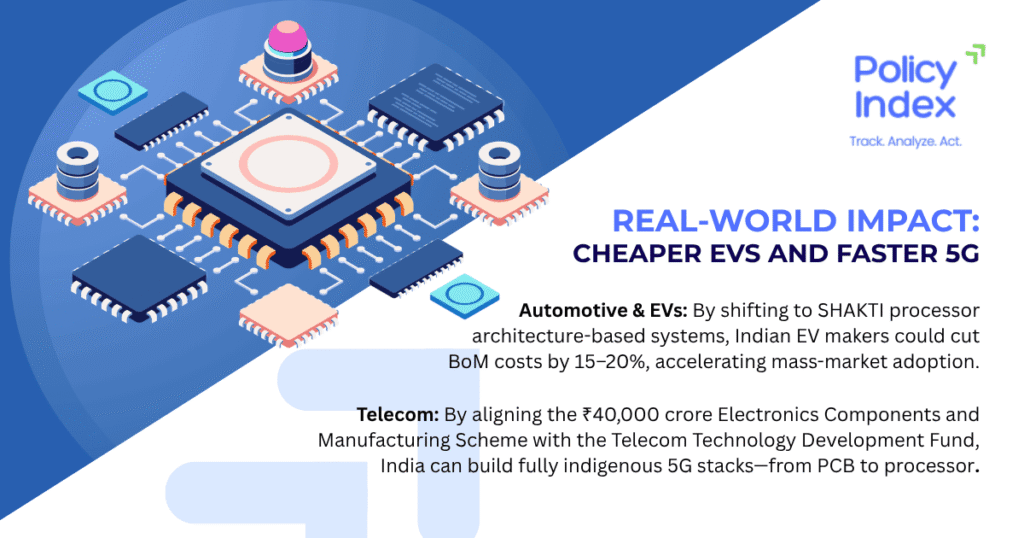
This isn’t just academic. The shift to indigenous IP has massive implications for the hardware we use every day:
- Automotive & EVs: By switching from imported controllers to SHAKTI-based architectures, Indian EV makers can slash their Bill-of-Materials (BoM) by 15-20%. That’s the difference between an EV being a luxury and a mass-market reality.
- Telecom: We’re looking at a “Full-Stack” 5G dream. By aligning the ₹40,000 crore ECMS (hardware) with the Telecom Technology Development Fund (silicon), India can build 5G towers that are indigenous from the PCB up to the core processor.
4. The “ChipIN” Advantage: Lowering the Barrier to Entry
Designing a chip is expensive. A “tape-out” (the final design result before sending it to the factory) on an advanced 7nm node can cost a fortune—enough to kill a startup before it starts.
ISM 2.0 addresses this with the India ChipIN Centre. The goal? A 75% tape-out subsidy for advanced nodes. This effectively reduces the “cost of failure” for Indian startups, allowing them to experiment with high-performance silicon that was previously the playground of only the biggest global players.
5. Protecting the Win: The Sovereign Patent Defense Fund
In the tech world, if you’re successful, you get sued. Predatory litigation is a real threat to small fabless firms.
One of the most forward-thinking recommendations in the ISM 2.0 framework is the creation of a Sovereign Patent Defense Fund. This would provide domestic startups with the legal muscle and patent firepower to defend their “Full-Stack” designs against international giants. It’s about making sure Indian innovation isn’t bullied out of the market.
The Bottom Line
India is no longer content with just “Making in India.” We want to “Design and Own in India.”
With a talent pipeline growing to 85,000 engineers and a clear roadmap toward IP sovereignty, the next decade of the semiconductor industry might just have a distinctively Indian accent. For enterprises and investors, the message is clear: Align with the RISC-V standard, leverage the ChipIN subsidies, and get ready for a future where India isn’t just a consumer of tech—but its primary architect.
Read the latest whitepaper “The IP Sovereignty of India’s Full-Stack Semiconductor Future under ISM 2.0”, where we transform complex regulatory data into executive-grade intelligence. For deep-dives into semiconductor policy or bespoke impact assessments, reach out to us at advisory@policyindex.ai.